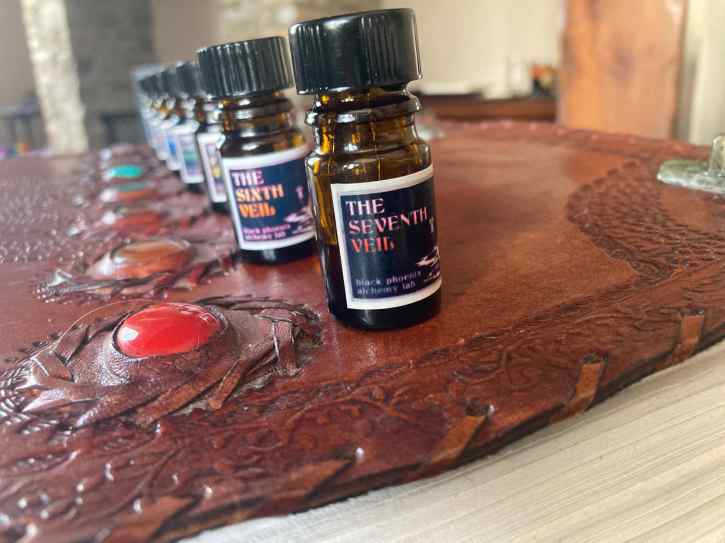
I cannot remember the last time I dropped in to write one of these, so I imagine that many of you may wonder what the heck I’m doing. Well, scent is a huge part of my writing process. I use perfume oils to evoke characters, settings, and tones for myself as I draft of revise a story. And 99 times out of 100, the perfume oil I’m using comes from Black Phoenix Alchemy Lab (BPAL). They’re cool–making stuff that no one else makes. You want to smell like mown grass? old books? campfire? the undead, newly risen? bubble tea? wrapping paper? hot electronics? wet wrought iron? horse stables? sex sweat? a fresh tomato? pizza? pizza BOX? They’ve got you. Really.
So, what I like to do sometimes is post reviews for their oils–how they smell wet, and how they smell dry, and also a writing prompt the scent inspires from me. I want to try that last part a little differently this time. Instead of a prompt, I’m going to say what sort of tones/characters/settings I think the scent could help to evoke in creative work.
Today, I’m posting about BPAL’s Seven Veils scents and, uh, here’s the thing… they go down from the website TOMORROW. Did you hear me? Today (31st July) is the last day to get them. So, you know. If you’re inspired, strike like lightning.
Starting WEDNESDAY! Still time to sign up, and play in the Gothic sandbox with me, in my Dread & Desire course on Gothic writing techniques! We’ll do some reading, some thinking, some playing, some chatting, and most importantly some WRITING–with feedback from me!
Useful for anyone writing anything a bit dark, from suspense to thriller, fairytale to fantasy, and of course horror! More info, and sign-up, via the link:
Starting in just one week (Feb 19th), I am taking as many people as I can from the beginning of their novel draft to typing “the end.” I love doing this: I recognize the great trust writers place in me as readers of works-in-progress, and I do my best to reward their vulnerability–and bravery!–with helpful weekly craft readings, compassionate and conversational weekly written lessons, and open and honest weekly office hours for all the questions and concerns that come with the writing process.
If this sounds like something you want to try, I want you there. Drafting a novel is hard, but you don’t have to go it alone. In fact, you shouldn’t: so much of what makes drafting daunting is in the solitude! It lets our insecurities build, and our struggles go unvoiced–and so, unsolved!
Starting 9/25: DREAD & DESIRE: GOTHIC FICTION TECHNIQUES TO LURE & HORRIFY YOUR READERS
We’ll mine Gothic fiction for techniques to entice & terrify readers, then try them out on each other in our writing submissions. You’ll get feedback on your work from me, plus weekly Zoom class discussions.
It’s that time again! I’m running a 16-week course over on Writers dot com to help YOU get that first draft written. I’ll come armed with readings from craft books, ready to give you feedback on your submissions and all the encouragement and perspective you need. Starts at the end of August!
I was sixteen when I told my mom I wanted a sex change.
She took a beat of silence, and said: “You can do whatever you want once you’re eighteen.”
Of course I understood that, while she had not said “no,” there was some reticence in that response. For what would change upon my turning eighteen? Only her legal power to stop me making such a move.
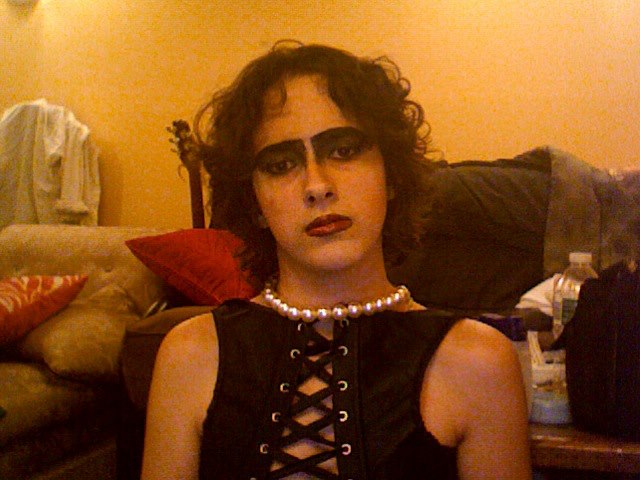
I puzzled over her (very gentle) dissuasion. My mom was the person who made me watch The Rocky Horror Picture Show when I was 12. I wasn’t interested, myself; Janet Weiss smacked of Sandra Dee, and Brad Majors was not my type, so I tried to walk away from it several times in the first quarter of an hour. I much preferred my film version of Cats, with John Partridge as Rum Tum Tugger in all his gyrating, Spandexed glory. But Mom insisted I stay until Tim Curry came down that elevator shaft.
“Is that a man or a woman?” I asked.
She nodded toward the TV. “Just watch.”
But what I did, when I whipped my head back toward that screen, was not so passive as just watching. I was cataloging Dr. Frank N. Furter’s every article and eyebrow twitch for science. I had never known something like this was possible. And if this was real–if enough people existed to produce a film, a scene, a character such as this–what else was there to find? I wanted to pin it all down, for keeping in the curio cabinet in my head. And while I was transfixed, Tim Curry’s velvet voice reached down my own throat, like Ursula’s spell—but instead of a vocal cord, it was a heartstring he took hold of.
Mom knew that he had me. The moment he had gone away, back up the elevator, I turned and asked again: “Was that a man or a woman?”
This time, eyes twinkling, she replied: “Does it matter?”
I was in my twenties here; nobody panic.
Mom joked in the years after that her options at the time were, either, to show me Rocky Horror or to have “the sex talk” with me herself. And certainly her decision colored my sexual awakening. I spent every October of my adolescence at Rocky. One year, fresh out of spending money, the director of the live show stopped me leaving after the 8pm performance, and comped my tickets for the midnight one, because he needed me: I knew every call-back. Another year, on closing night, when every member of the cast was given a rose, I got one, too. I made myself a fixture, and meanwhile I fell hard (at a distance) for every Frank N. Furter I encountered—and one towering, teenaged Riff Raff.
I was in acting classes myself then, working on scenes for recitals that tied together the work of the ballet and tap cohorts as well. Rocky Horror was a language I could use to get closer to the kind of boys I was drawn to, all my different Frank N. Furter t-shirts acting as beacons. I have distinct memories of the star ballet boy—a redhead of lithe limb and princely presence—who generally had time for no one, but who would on purpose find me (me!) in the backstage corridor of our practice space, and whisper a line of “The Time Warp” close enough to blush my ear with his breath. I had no hope of answering; he always at the other end of the hall by the time I could turn my head. But he looked back, to see his effect on my face, before he disappeared.
None of these experiences materialized into anything like a relationship. Either my feelings went unexpressed entirely, or else I did express them to learn explicitly that they were not returned. But you mustn’t imagine, dear reader, that I was ignorant about the kind of boy I was drawn to. I knew that they were very probably interested in other boys. But here’s the thing: the revelation of Tim Curry’s Frank N. Furter, for me, was not just “whoa, I like dudes who like dudes.” It was also: “oh, dudes who like Brad can also like Janet.” Once that suggestion was made, outside of myself, I felt around inside myself and affirmed it there, too: I have never, up to now, admitted widely that I was pursuing girls my age, as well as boys, as a teen. In fact, my first real adolescent relationship was with a girl, and lasted several months. I was capable of wanting either.
And if I could do it, so could anyone.
Thus, my confidence—not ignorance—in presenting myself before all of them (Riff Raff, ballet boy, and others) with much vulnerability and some hope: as far as I was concerned, my fate was not predetermined by my gender, but rested on each individual’s pronouncement on me. Just because one gender-subversive person said no did not mean that all future such people would say the same.
Not that I bore all the rejection easily.
On an eighth-grade field trip to NYC to see Phantom of the Opera, I pressed my face against the window, headphones on, mind in the middle of Pink Floyd’s The Wall, probably, or else Modest Mouse spreading the Good News for People Who Love Bad News. I shut myself away all the time, staring out as the world went by, acutely feeling my loneliness. But on this day, a vividly blue eye peeked back, through the gap between the coach bus seat and that window, at me.
It blinked. A shift. Lips. A pretty boy I knew by sight—someone I’d seen when I went to visit my favorite English teacher. He wanted to say something to me.
I pushed my headphones down around my neck.
“Tragic,” he whispered, “that so beautiful a girl should look so sad.”
And that girl smiled henceforth, through what was then a date. The first of many.
How refreshing, to be pursued—and by my sort of boy, too. Unfortunately, that boy would use Rocky Horror against me. When I said I wasn’t ready for a certain sex act, he said, “’Don’t dream it, be it,’ right?”
I had had to say “no” a second time, so I resolved never to call him again.
When he transferred to my high school two years later, he was out as gay. Actually, I don’t know how widely it was known. But he told me. He also flirted with me in study hall, asking me details about my romantic life (which I was too proud of not to share), and disparaging the boyfriend I was then dating. In ways subtle and overt, he suggested himself as a better alternative for me.
I had not forgiven the attempt at coercion from when we were younger, and held the line. But I registered his desire for me, and noted it down. Gay, I understood, was an only mostly useful short-hand for him: he was generally attracted to boys. He was also still attracted specifically to me. And I was a girl.
Wasn’t I?
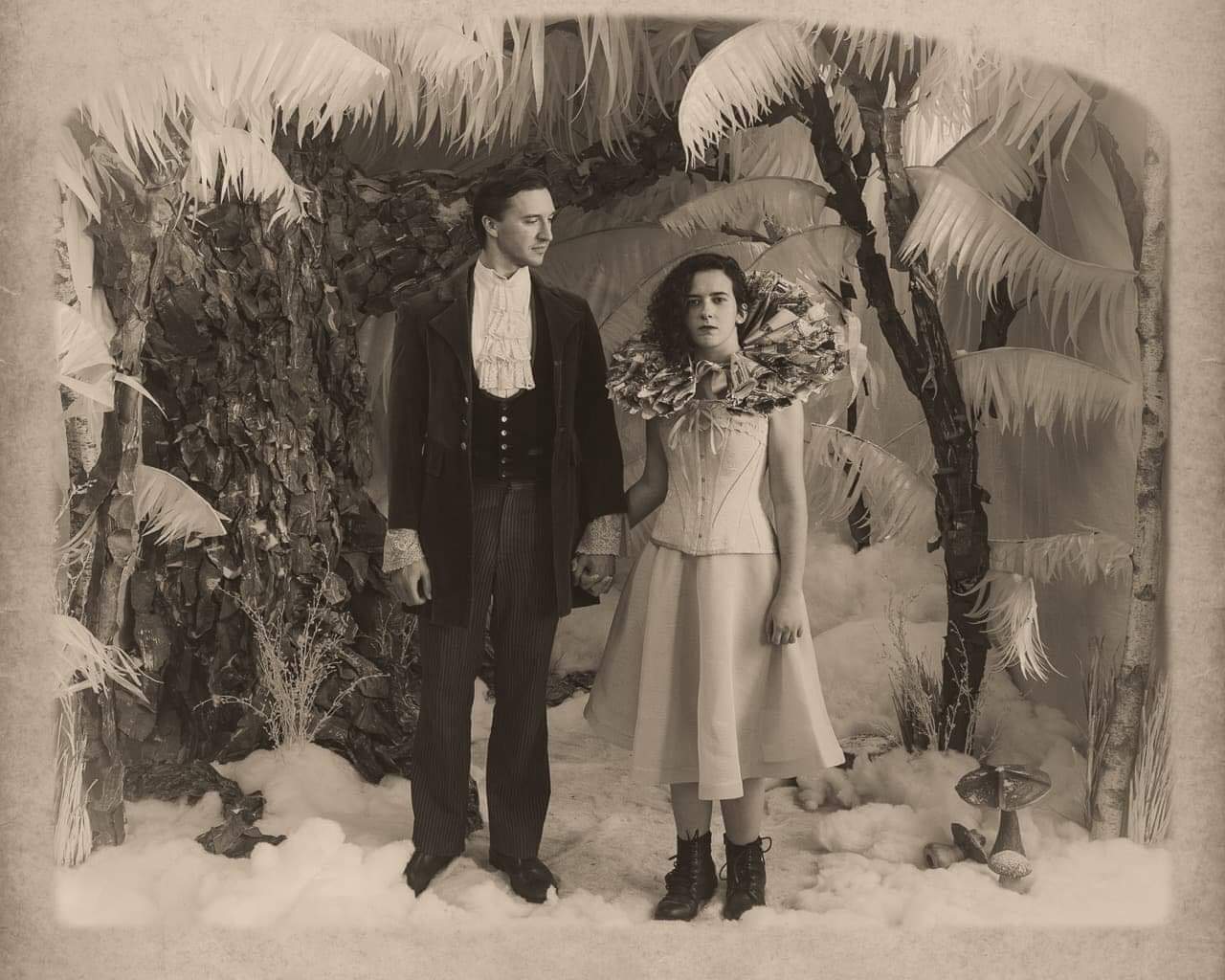
Photo by Adrien Broom
I had been watching Hedwig and the Angry Inch a lot, the year I said I wanted a sex change. I did that—watched and rewatched movies, played and replayed albums, until I could recite them word-perfect, play them back in my head. Maybe Mom said what she said, about doing what I wanted when I was eighteen, as a way to make sure it wasn’t just a flavor of the week kind of thing. Monkey see, monkey do.
And, by the way, my rewatch obsession right before Hedwig had been the newest Jesus Christ Superstar. I fell head over heels for Glenn Carter, but the film did not change my agnosticism.
The truth is, Hedwig was a push down a path I had already been walking. My high school encouraged us to come to school in costume on Halloween. The first year I went as Eric Draven from The Crow. The next year I went as Jack Sparrow. The next year I went as Eric Draven again, Mom was a little surprised. Hadn’t I already done that one? Why do it again?
I shrugged and said I liked him. I felt I could not, should not, say the fuller thing. That I liked it: the experience. That is, I liked that, by following the roadmap of these characters’ distinctive face make-up, and by donning certain identifying costume pieces—electrical tape around my hands for Eric, a tricorn for Jack—people might read me as a boy.
I was more conscious of myself, those days. I sat up straighter. I held people’s gaze instead of avoiding eye contact. I usually only raised my hand in English class, but on Halloween I tried my hand at everything—my electrical-taped hand, up high, so people would look at it, look at me, look, and maybe see, for just one second, a boy instead of a girl.
After I told my mother about what I wanted, I started going to school in jeans and t-shirts with my hair slicked back off my forehead, and asked the emo-band boys in my Civics class to call me Brian. And, for a wonder, they did it. Nobody made a big deal out of it. They made a point of trying to include me more in their conversations, when they might easily have distanced themselves.
Discomfort came more quietly, from within, before my bedroom mirror. Without the help of a costume, of a specific character to be other than myself, I could not believe in me-as-a-boy. I was too short, my face was too round, my breasts too big—which was especially infuriating, because as a girl I was very aware that they were considered too small.
But dammit, I liked them. I thought they were just right. For me.
Not measuring up to a standard was an ache I knew well, as someone with cerebral palsy. I already couldn’t walk the same as my peers. I already couldn’t do most of the things they could do: even something so normal as walking down a few steps without a railing is impossible for me.
Looking in my mirror, I found I just did not want to set myself another challenge. The very thought exhausted me. I fled back to the gender presentation of least resistance.
That, I think, is the real reason my mom said to wait: not to pass a judgment, but to make me take a breath, first. What I was talking about was another surgery or two, and in my young life I had already been through four big ones. I had had to relearn how to walk when I was ten. I got six new surgical scars on my legs before I got breasts. I had to turn my attention so completely to the progress of my gait that I was surprised, one day, to look up and find myself with hips. My relationship with my body was new, still, in so many ways.
Did I want to be more different? Did I want another reason to look at myself and think close, but not quite?
In practice, no. I couldn’t take that on. I had to acknowledge how much of my energies went to carrying myself, to accepting myself, in the body I had, as it was. Sometimes, making a change is a self-loving step. For me, in this case, the more self-loving thing was to stay the same.
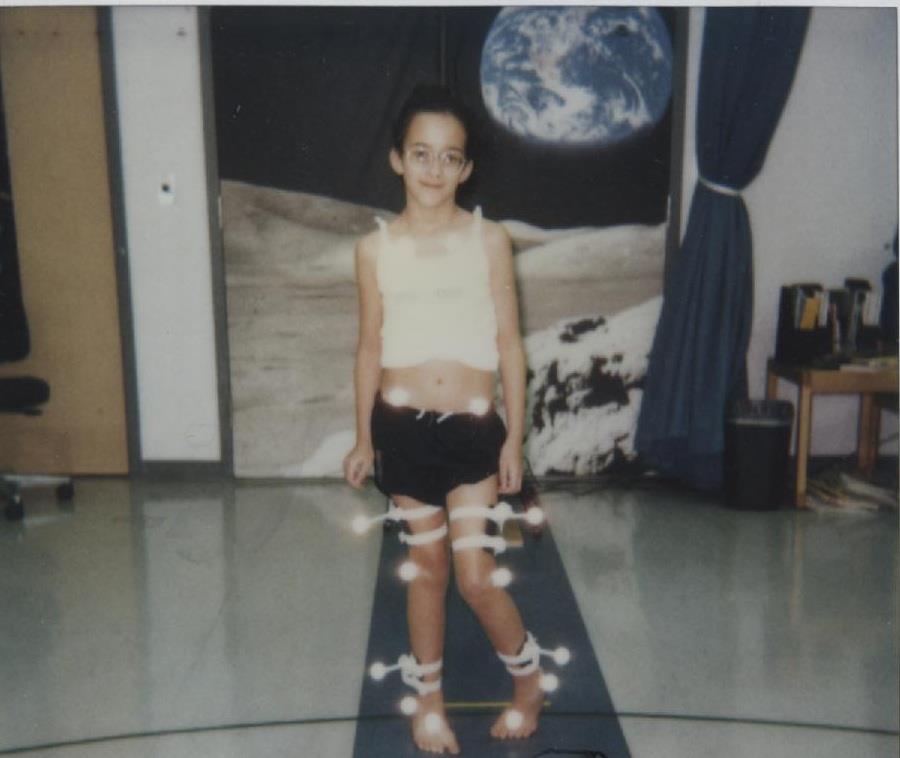
A gait study, pre-op for corrective surgery on both legs. I was ten.
But I wasn’t about to deny my gender-bendy insides. I bought a binder for when I was feeling fellowy. I started telling people “I aspire toward androgyny.” I made myself a student of gender in college, and delighted to learn in sociology classes all about what a deliberate performance gender is—and how different the expectations of the performances are, from culture to culture. I made myself comfortable again in the idea that my biological sex need not limit me at all: not my behavior, my aesthetic, my aspirations, or my possible lovers.
Yet I thought of myself as a heterosexual woman—even as I salivated for months over one of my Student Center lady friends, who was regrettably dating a rather gross guy. I was also dating a guy, at the time. Sometimes I wonder if we were eyeing each other, she and I, and never knew.
Whenever I considered identifying as bisexual, the knee-jerk thought would come: I am not attracted to most women, only some. And I say this part in case anyone else needs the kick in the brain that I needed. Are you ready for it?
I’m not attracted to most men, either.
This is the thing that lots of “nice guys” don’t get, right? That just because you’re a woman who likes men doesn’t mean you automatically like every man. I realized: the sub-set of men I am attracted to is a minority of men. And I don’t think my queer taste has anything to do with that. Another (het) woman’s taste in men might be different, but she certainly has a taste, period. I suggest that, no matter what her taste is, there are certainly plenty of men it necessarily precludes from her desire.
It would be an illuminating exercise for anyone, I think, to sit in a mall or park and try what I tried: noticing every example of my professed sexual preference that I was, nevertheless, not attracted to. My liking a man, it turns out, is the same sort of unusual occurrence as my liking a woman—I thought of the latter as the only surprise, of the two, because I have been taught to expect to like men.
Lots of folks know that I spent a decade of my adult life in a closed throuple with two queer men. I’ll tell you this: I might be in it, still, were people’s expectations about gender and sexuality not so rigid—even within the queer community, even among our supportive friends and family, even within my partners and myself. I wish I had believed harder, had fought to defend that truth which has been suggested over and over to me by my lived experience:
Every instance of desire is, in fact, exceptional.
At least, I am the healthier now for treating each of them as such. Searching less for vindication in someone’s gender performance, or their sexual history, and focusing instead on the solid substance of the specific connection between that person and me.
“Do you want me?” is not a question that can be answered by educated guess—based on probabilities, then marked on a sliding scale.
“Do you want me?” is a binary question—the only binary I really give a shit about.
TL;DR: I’m a genderqueer, pansexual person (and I don’t care what pronouns you use for me in good faith). Sorry I’m just telling you now—it happened while I wasn’t looking.
I’ve been struggling with revising the beginning of The Next Novel. Not because I don’t know what happens to set my protagonist on her journey—I do. I can see her history winding behind her like a river, pretty far back, before it curves out of sight for me. The trouble is: where should we join the main character’s stream of experience, and begin to walk beside her?
Now, I love a good craft book, or a lecture on craft, and I’ve heard lots of authors talk about beginnings. Part of the balance is in making your readers ask just enough questions. You want them to a) have enough knowledge to make sense of what’s going on and b) enough curiosity to wonder about what comes next. You want them to have a manageable amount of questions for you to answer over time.
But in the case of The Next Novel, this awareness of a reader’s cognitive load isn’t helping me. I’ve now written four different opening scenes to the story (by which I mean they start at distinctly different points in the narrative—whereas, if we count all the times I’ve tried to revise from each of these points the number of beginnings I have sky-rockets). They all work in terms of manageability. Yet they all leave me uneasy. They feel wrong.
So I looked elsewhere for the issue, and started wrestling with where the story is within my main character’s larger experience. There’s a great lyric in Everlast’s “What It’s Like” that goes, “You know, where it ends… usually depends on where you start.” This is true for the human experience, start (birth) to finish (death): our time of living is limited, and our options within that life will be further limited by what we do and don’t have at our disposal as we move through that time. We get where we get, and then it’s over.
Craft books and lectures hint at an opposite truth, when we move from experience to story: where you begin… usually depends on where it ends. It’s like when we tell stories to friends about that first date we had, the job interview, the incident at the movie theatre with a stranger: because we know the outcome (happy/sad, absurd/exciting, disappointing/satisfying) of this smaller piece of our whole lives, we make choices about our own delivery that serve to both a) keep our listening friend invested and b) make the ending as powerful as possible: its tone, the details we share, the details we leave out and, most importantly of all, where we begin.
This is why I (and plenty others) recommend to writers that they don’t sweat the beginning until they’ve written “The End.” I say they have to experience the entire thing they are writing before they can begin, through reflection, to tell it mindfully as a story.
So it makes sense that the next thing I’ve interrogated, to strengthen the beginning, is the Next Novel’s ending. Not just “Am I happy with how things turn out for my protagonist?” but “Does my beginning have enough to do with my ending?” If the difference between my protagonist’s life and self at the end, and her life and self at the beginning, is a chasm (as it should be!), does the bridge across that chasm—the story arc—have a certain symmetry in its build? This is important in bridges, and not just for aesthetics; if they aren’t built to bear weight evenly—or, if they cover too wide a span without regular support from underneath or overhead—then they will fall apart and anyone in the middle of crossing is gonna be in big trouble.
This is where I started revising those four different beginning points I had, with an eye to bridging the beginning to the ending I have written (and love very much) in my first draft.
In the first beginning, my protagonist argues with the powers-that-be; at the end, she’s arguing, too, just in a very different context—to very different results. The biggest change from there to here is in her surroundings, and so all I had to do to heighten the contrast was draw special attention to the stakes, the power dynamic between her and everyone else, in both scenes.
In the second beginning my protagonist gets caught mid-crime; the ending also has an element of her being guilty of a misdeed. The biggest change from there to here is in her sense of guilt/responsibility, and so all I had to do to heighten the contrast was draw special attention to the emotions driving her behaviors in the face of judgment.
In the third beginning my protagonist takes advantage of someone for personal gain… In the fourth beginning my protagonist confesses to wrong-doing in the hopes of getting help. I did this work for beginnings three and four as well. I built both ends of all four bridges to match each other, and… still wasn’t happy with any one of them. All the bridges would get a reader from one end of the chasm to the other, and yet I still worried. I worried that, as sturdy as the bridge was, a reader might not want to bother crossing it.
But why? If the arc bridge is story-worthy, and the beginning of the walk across is neither boring nor overwhelming, what’s bothering me?
It’s gotta be my protagonist—the person beside whom I’m asking readers to travel.
Have you noticed? She’s no goody-two-shoes. The story starts, as many do, with her getting herself into trouble. Despite my hardly giving you any specific details, it’s clear that she picks fights, acts out, takes advantage, and knows that what she does—whatever it may be—is not the best course of action in the eyes of others. She could, if I’m not careful, be deemed (gulp) an unlikeable main character.
That’s not always a story-killer. But with main characters who are women, it can be especially dangerous.
But see, I am careful. That’s why all four of those beginnings are designed to include (at least) allusions to the deep trauma the protagonist has suffered, and (at least) hints of the dire straits that force her to act the way she acts. She does bad things, but when she does them I make it clear that she really has no other choice. What more can I do, to make her a worthy travel buddy?
At the same time that I was having this struggle, three things happened (not in quick succession, mind you):
The first was that a student in a writing class discussion mentioned how tired they were of sexual trauma in women characters’ backstories. She said that she knew plenty of strong, decisive, interesting women in her life, and that their strength, their value, didn’t come from their trauma.
At the time, my response was statistical: a majority of women have experienced, or will experience, some form of sexual trauma, ergo it would make sense that sexual trauma would figure into a majority of women characters’ stories. The discussion moved on, and I didn’t think much more about it.
The second thing that happened was I accidentally saw a negative review of On Good Authority. (When I say accidentally, I really do mean that: I like to check my Goodreads stats, like anyone would, so that puts me close to danger—but I believe reviews are for readers and are none of my business. I can only be grateful that someone would be willing to spend their time reflecting on what I made, regardless of what the content of that reflection is.) It was a short review—which is part of how I managed to take its meaning in before scrolling away: this reader felt that no one in the book was likable.
And the third thing that happened? I ended a relationship, for the first time in my life, before someone could hurt me—on the basis of being pretty sure they were going to hurt me in the future, if I let them stick around.
Only after I had done it did I realize that I had never done it before. In the past, it was always my way to give folks the benefit of the doubt until all doubt had been removed. My letting go in the aftermath of being hurt was always awful—because I was hurt, of course—but at least it felt justified: like anyone could understand why I was walking away, based on what had happened to me.
I guess a fourth thing happened, too, which is the thing that always happens: I took a shower. (I owe a lot, creatively, to the inventors of modern plumbing.) I was working through The Beginning Problem in the Next Novel once again while I washed up: what more could I do, in the first chapter, to make my protagonist worthy of walking beside?
I was so tired of this issue. And not, I reflected, because I was tired of this manuscript. Rather, it dawned that this isn’t just a plot problem, for me. This is a life problem. I worry, so much, about what people think of me and everything I do. I have a history of hiding my hurt from other people so that I won’t upset them. I have a history of hiding my frustration because, if I can handle it myself, what good do I do anyone else by sharing it? I have a history of holding my tongue about my fears, my misgivings, until the worst has already happened—because only after the fact can I be absolutely sure that I was right, that my point of view was unassailable and, thus, worth expressing.
Standing up for myself at the expense of someone else’s comfort puts me in danger of being an unlikable character. And I certainly don’t want to walk my life alone.
That was when that review of On Good Authority popped back into mind. Not because it hurt me, but because it puzzles me. I tried to make Marian Osley, the protagonist of that book, as good as I could. Like, it’s her whole thing. She’s what my other former husband and I would call a “justice junkie.” They both are—her and Valentine Hobbs, the love interest. I did everything I could think of to make her likable, and not in a manipulative way… I mean, I made her someone I liked. I think she makes sense, in that way that I would like to make sense to others at my most apologetic. She comes from the me who hates to hurt people, or disappoint them, or inconvenience them in any way.
And yet, not everybody likes her. From this, standing in the shower, blinking water out of my eyes, I extrapolated:
Maybe I am not in danger of being an unlikable character, if I stand up for myself. Maybe I just am an unlikable character, no matter what I do.
And not in a woe-is-me way. Not in a sweeping judgment, eternal damnation kind of way. More prismatic. More 3-D. There are a bajillion ways to look at me—a bajillion places to stand, a bajillion lenses to look through, and so, so many lights to stand me in. Even if I take the time to make myself look just right, as far as I’m concerned, I’m only one concerned person. Everybody’s gonna take their own read, on everything.
And then, I remembered the comment about how sexual trauma comes up so often in women character’s backstories. And I thought: maybe that student wasn’t talking about the inclusion of sexual trauma in fiction, but more the purpose it was serving, as tiresome. Maybe she was saying that women characters are worth our time, our wanting them to have success, without having to prove that they have suffered enough to “deserve” that success?
What if those sorts of backstories are common for a sociologically/statistically common reason, but not in the way I thought? You know, where it ends… usually depends on where you start. What if it’s not just about the prevalence of sexual trauma in reality showing up in story, and it’s also about another sociological struggle: that, because of their experience, women writers are—that I had been, that I still am—afraid that a woman who makes choices in advance of experiencing deep trauma, in anticipation of hurt, will have no one willing to walk beside her?
What if my discomfort with the beginning isn’t my protagonist’s problem? What if it’s mine?
I asked myself: what if I did less to make her “worthy” to walk beside? Who would she be if her past didn’t have to be the most awful, in order for her to want to pursue a better future? Where could I start her story if I didn’t have this deep need to perfectly justify her first, imperfect choice?
The answer came at once. A fifth beginning. I got out of the shower, and back to the desk, and now I have a bridge to test.
Looking over my shoulder, I think about 2023 as my “Wonka year” (“You see: nobody ever goes in… and nobody ever comes out.”). No sooner had On Good Authority hit shelves (my debut novel! the stuff of my wildest dreams!) than I disappeared… or, at least, receded. I DID do things—for this book, and the next book—but it was less than I imagined I would do. By a lot.
“I’m a mess, but I’m here!”
Because something else was happening, behind the scenes of my book launch: my family of over a decade was breaking up. Had been breaking up. I got the news that On Good Authority was going to be published literal days after we in our throuple had decided on divorce, back in the summer of 2021. There were no villains, we all still loved each other, it just wasn’t working anymore—and that made it hurt even more.
I had been imagining for years, how we’d all cry and hug and party if my book finally sold… And the reality, when I got that e-mail at last, was the three of us sitting in separate corners of a room, restrained. Happy, but sad. Feeling the huge, deep difference—between how it could have been and how it was.
I kept the dissolution of my family, our home, to myself for months. I was terrified that my publisher and my agent would lose faith in me, or see me as a bad bet, if I confided what was going on. I have memories of crying at my desk, staring at revisions that were due soon, trying to think my way from how things were to what they absolutely must become—in the draft, in my life—when all I seemed to have in my head was hissing, strangling static.
I didn’t know how to fix the book up while I was falling so irreparably apart. I didn’t think I could.
I held it together. I mean, I think I did. I turned in the revisions, often at the very last moment. I did launch events and readings—one of these on the literal same day I moved out of our home of a decade.
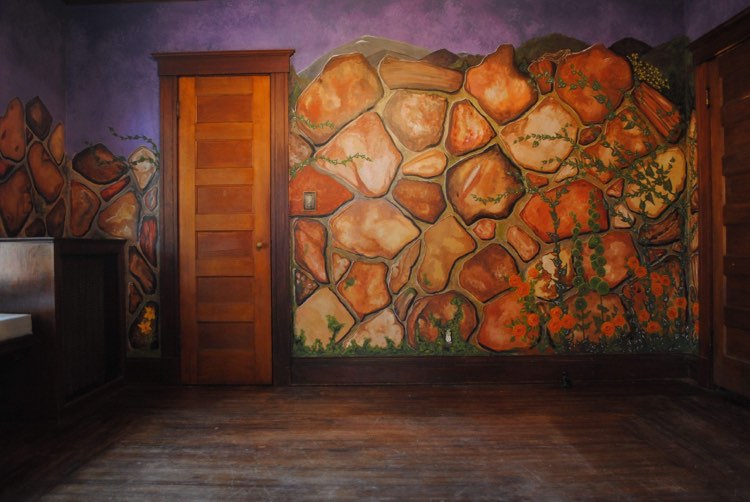
My office, empty. My husband painted a new flower every time I achieved a writery thing.
And then, at the end of 2022, when nothing else was due, or expected of me, I fell all the way apart. I was exhausted. And I had a lot of hurt to feel, which I’d been putting off, while we all let go of our home, our life. I don’t know that I meant to hibernate for all of 2023… But I certainly quieted down.
But Willy Wonka never stopped making chocolate, even with all the doors locked, and neither—metaphorically—did I.
I’ve been working on The Next Novel, slowly but surely. Word by word, in changing chairs, from familiar to new, strange rooms. The story is dark and sensual and weird, like me, and I am, I think, mere months away from turning in a revised version. I can’t promise what will happen next—that’s not up to me—but I can say I’ve come out the other side of my seclusion with something to show for myself.
The first line in “A Match for Death” is “Life was nothing if not a learned woman.” I’m proud of that.
The other, “His Cup of Tea”—perhaps the weirdest and most heartfelt thing I’ve ever written, which has been looking for its right home for a decade, landed in Artifice & Craft from ZNB. It’s so perfectly right that this story should come out now. If you are looking to support me, and know me a little better too, either anthology is a good bet, but… I’d especially urge you to try Artifice & Craft.
“His Cup of Tea” is about a boy who paints teacups… and so much more. If you like Tori Amos, know that the first time I heard “Weatherman” I about did an actual spit-take, because I had just finished revising this story.
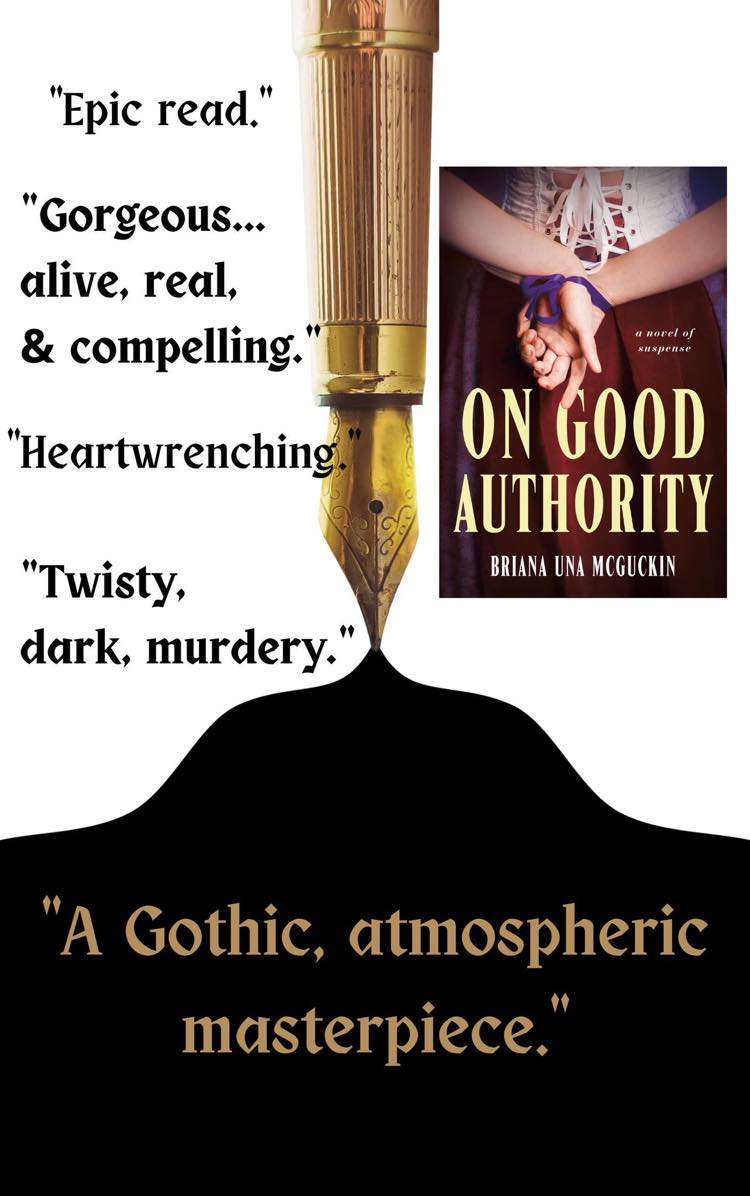
And hey, if you haven’t read or reviewed On Good Authority, my coming-of-age kinky, Victorian Gothic debut, it’s out here waiting for you to find it.
Tess of the D’Urbervilles meets the film Secretary
Meanwhile, the next story is coming, in all its queer, dark-academic historical glory. And I will make it worth the wait.
I haven’t done one of these in a while! This time, I have generously been given, to review, Black Phoenix Alchemy Lab’s new collaboration with Junji Ito: TOMIE perfume oil, inspired—of course—by the horrific (and brilliant, socially critical, feminist) graphic novel of the same name. The Tomie perfume oil is currently available here, via the Black Phoenix Alchemy Lab website.
NOW–on with a review!
Tomie, Black Phoenix Alchemy Lab
Scent Description: “What’s so precious about a monster?”
A seductive and deceptively delicate blend of rose-tinted white sandalwood, ethereal white amber, voluptuous almond blossom, coeur de jasmin, and a gasp of bourbon vanilla.
Scent Review:
First on, there is an almost-anise quality to this. I suspect it’s the jasmine and almond blossom playing together with the bourbon vanilla. Or, perhaps it’s not anise-y at all, but my brain is making a link between this and those frosted, anise Christmas cookies. That’s not to say that this is foodie… It’s decidedly floral. But it has that chill of an anise cookie to it. That’s what really matters here: it’s a smiling scent, but the smile is cold. Not threatening, but… it is a screen of a smile. It’s hiding something.
A little later on, I have written: metallic floral. And I didn’t know that that could be a thing. But again, it’s that coldness doing it. This isn’t mint-cold. It’s not snow-cold. It’s… aloof cold. Because the chill is coming from multiple notes, I think, what I’m getting is more emotional—or rather, emotionless—than a literal, identifiable cold thing.
Don’t get me wrong: this scent is pretty. Seductive, alluring, and youthful—just like Tomie. But it’s hard, too. It’s got a brusqueness about it. It’s not a soft floral. It’s not a loud floral, either, though. It’s… a scent that says, “don’t fuck with me” without ever raising its voice, or dropping its sweet expression. It’s too youthful a scent to think it could do you any harm… and yet, you are a bit unsettled by it.
My last note, at the oil’s driest, was: “monochrome floral.” Which I think is apt. It’s got a starkness to it, like the black and white comic pages by which it is inspired. It has that starkness of the page. But remember, Junji Ito skillfully wrought those hard lines into Tomie, over and over and over, death after death; despite the harsh medium, the apathetic cruelty of the world around her, she comes through so beautifully. The same is true for her here, in scent.
Writing Prompts:
Non-fiction: This has me thinking about people and things which look innocent enough, but cause great harm when hapless people get too close. Do you have an experience like that? Were you the not-so-innocent one? Write about it.
Fiction: Write a short story in which the same thing keeps happening, over and over—but each time under different circumstances, so that the middle bits begin to hold a larger meaning.






 Briana Una McGuckin